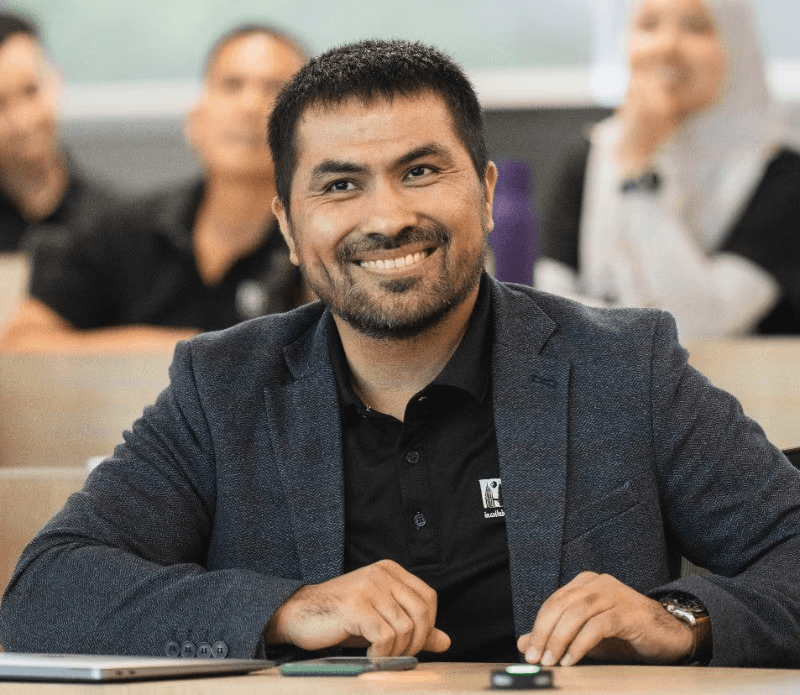
Associate Partner, Islamic Social Finance
Hoji Mirzakulov
Hoji leads Dunecrest's Islamic Social Finance practice. He is a strategy and market intelligence consultant who has spent his career on feasibility work: establishing whether something will work commercially, at what scale, under which regulations, and on what evidence. He brings that discipline to a field that has historically relied more on conviction than on numbers. His remit at Dunecrest covers Islamic social finance alongside sustainability and climate-linked instruments across Saudi Arabia and the wider Middle East and Africa, including engagements connected to the Islamic Development Bank ecosystem.
His technical foundation is in feasibility and market analysis for development banks, government-linked institutions, and large corporates across Asia Pacific, Europe, the Middle East, and the Gulf. He has contributed to an energy infrastructure business feasibility study covering an LNG supply chain, running the market ecosystem mapping, demand forecasting, supply chain cost analysis, and scenario and sensitivity testing that produced the go or no-go recommendation. He has led a primary-research market sizing study for the packaging waste sector across two emerging markets, interviewing collectors and recyclers to validate assumptions and building a structured model of waste generation, recycling capacity, and country-level collection rates, which allowed the client to set collection priorities and shape its circular packaging strategy. For a Fortune 500 Japanese conglomerate he built an agritech market entry strategy aligned to Singapore's food security programme, including the regulatory analysis, resulting in three partnerships.
His most methodologically demanding work has been in putting a value on things markets do not price. He led an economic and socio-economic valuation study of the contribution of migrant domestic workers across Hong Kong, Singapore, and Malaysia, designing the methodology and metrics from scratch, running primary surveys with around three hundred workers, building the valuation model with documented assumptions and proxy-based estimation, and triangulating the results against government and academic sources. The study quantified their economic contribution while capturing their social value, including their role in enabling female workforce participation and reducing household caregiving burdens. It was covered by TIME magazine in 2019. That combination, of rigorous valuation applied to social and care economies, is directly what Islamic social finance instruments require if they are to attract institutional capital rather than only donor goodwill.
He has also designed financing products directly. Working for a development bank in Malaysia, he designed two new financing solutions for underserved small and medium enterprise segments, including a product for women entrepreneurs, building the product economics and the ecosystem implementation plan behind them. He has led commercial due diligence for acquisition and market entry decisions, including target assessment for a specialty chemicals acquisition and support to a five billion US dollar technology company's pivot from hardware to integrated solutions, which led to the acquisition of a machine vision firm.
Earlier, Hoji was director of projects in the group founder and executive chairman's office at UCSI Group, leading firm-wide transformation and the launch of new service lines in market intelligence, capability development, and Blue Ocean Strategy. He spent six years at Frost and Sullivan, progressing from consultant to principal consultant, where he managed a portfolio of more than one million US dollars in annual recurring revenue and led a team of around eight consultants and analysts across Europe and the Middle East. He began his consulting career at UCSI Consulting Group, delivering research and strategy work for conglomerates, development banks, financial institutions, and universities across Malaysia and the ASEAN region.
Hoji holds a master of business administration from the Asia School of Business, established in collaboration with MIT Sloan, where he was a fellowship recipient in the top ten per cent of his cohort, served as a research assistant in operations and supply chain management, and completed the MIT Sloan global immersion in Boston. He is a Chartered Islamic Finance Professional, a postgraduate qualification from INCEIF University in Malaysia, which he completed on a President's Scholarship, and holds a bachelor's degree in economics from the University of World Economy and Diplomacy in Tashkent. He is a certified Blue Ocean Strategy trainer with MaGIC Malaysia and a mentor to early-stage founders at SME Bank Malaysia. He has contributed to Buyuk Kelajak 2035, Uzbekistan's national strategy initiative, on economics and small business development, and has published with TIME magazine, Enrich Hong Kong, and the Singapore Exchange. An Uzbek national working between Tashkent and Kuala Lumpur, he speaks Uzbek, English, and Russian, with working Arabic in Islamic finance terminology.