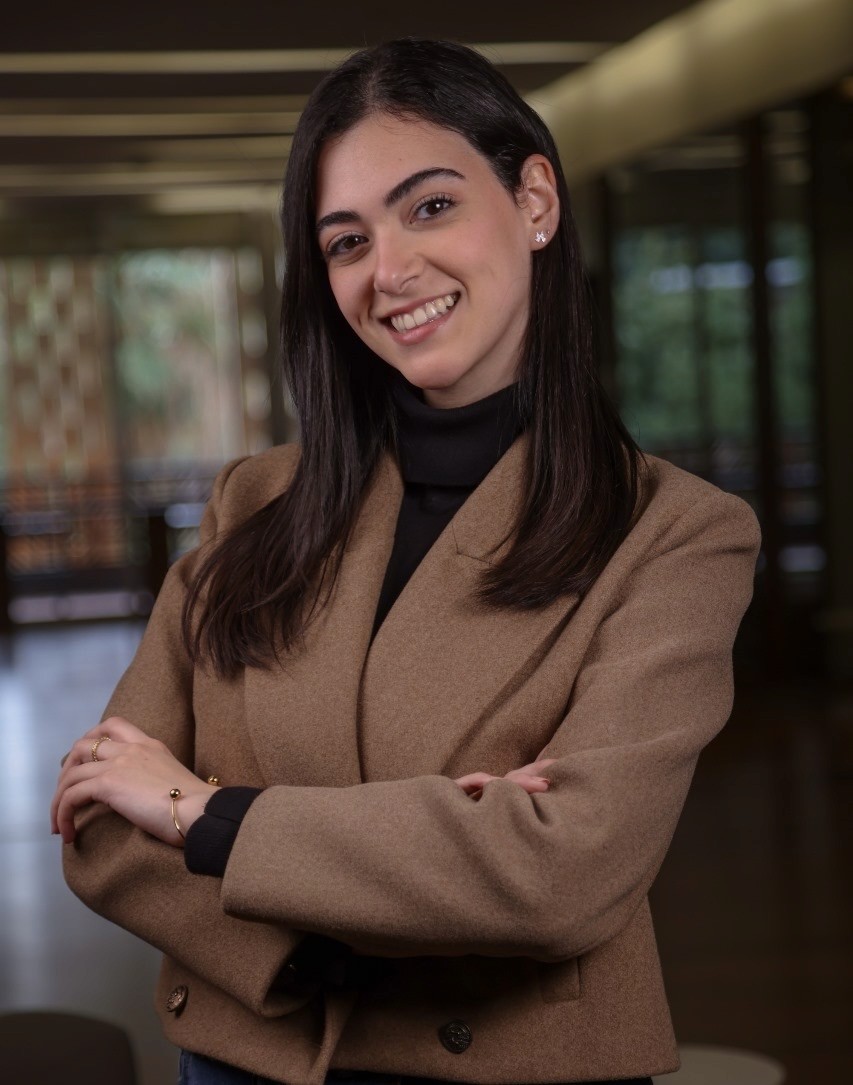
Associate Consultant
Mira Machmouchi
Mira is an Associate Consultant with Dunecrest. She is an economist and policy researcher whose work has concentrated on environmental policy evaluation and the water-energy-food nexus, the area where climate, resource scarcity, and economic policy meet and where most of the difficult trade-offs in the region actually sit. Her strength is in building the evidence: designing evaluation methodologies, running surveys and interviews, and doing the statistical and econometric work that turns a policy intention into something that can be tested.
At Dunecrest she has contributed to the firm's regional programme with the Global Green Growth Institute on strengthening private sector climate finance readiness across Palestine, Jordan, Lebanon, Iraq, and Oman, working alongside colleagues on the research and analysis underpinning the engagement.
Her research foundation was built at the Climate Change and Environment Programme of the Issam Fares Institute for Public Policy and International Affairs at the American University of Beirut. There she led environmental policy evaluation and citizen engagement analysis for two European Union-funded projects, PHEMAC and Nexlabs, both concerned with the water-energy-food nexus across the European Union and Mediterranean partner countries. She organised an international conference to develop and present a project evaluation methodology aimed at fostering job creation and small business opportunities from nexus projects, and supported the wider research programme through literature review, data collection, survey and interview design, statistical and econometric analysis, and budget management. She is a co-author on the resulting publications, including work on mapping and capitalising nexus best practice across European and Mediterranean partner countries and on a framework for nexus-driven open living labs.
She has written on climate and energy beyond the academic setting. Her master's thesis examined the geopolitical weaponisation of energy and its impact on the economic, sociopolitical, and environmental pillars of sustainability. She has also written on food insecurity and climate change in the Middle East and North Africa region, and has work pending on climate change and adaptation efforts in the Arab states. In 2023 she served as a committee executive on the global Rotaract volunteer committee for COP28 in Dubai, leading the team that developed and delivered the Rotary International pavilion in the Blue Zone and coordinating volunteer applications worldwide.
Alongside her climate research, Mira works on gender and social policy. She is a researcher at the Center for Women in Business at the Olayan School of Business at the American University of Beirut, contributing to the centre's positioning as a regional hub on women's rights and gender equality through conferences, working groups, panels, policy briefs, and research. She has also coordinated a project at the Restart Center advocating for mental health legislation in Lebanon aligned with international human rights standards, funded by the European Union through Transparency International, running consultation meetings and public forums and compiling the findings. Earlier, at the Amel Association, she worked as a registration coordinator assessing the vulnerability and needs of migrant workers for voluntary return and cash-for-rent assistance, having trained in human trafficking screening and victim identification.
Mira holds a master of arts in public policy and international affairs and a bachelor of arts in economics with a minor in international law, both from the American University of Beirut. She has held successive leadership roles in Rotaract, serving as president of the Rotaract Club de Beyrouth, then as district executive covering nine countries, and currently as district academy vice president, where she designs and delivers training for new and continuing members. A Lebanese national based in Beirut, she works in Arabic and English.